
Angus of The Real Seed Company and Conor of CANNAMANtv have a new podcast episode talking cannabis landraces, preservation, hybrids, and British plutocracy in the modern and historic cannabis trade.
The photo shows a bottle of Collis Browne’s Chlorodyne.
Tincture of cannabis was an ingredient of Chlorodyne, along with capsicum, peppermint oil, alcohol, opium, and chloroform.
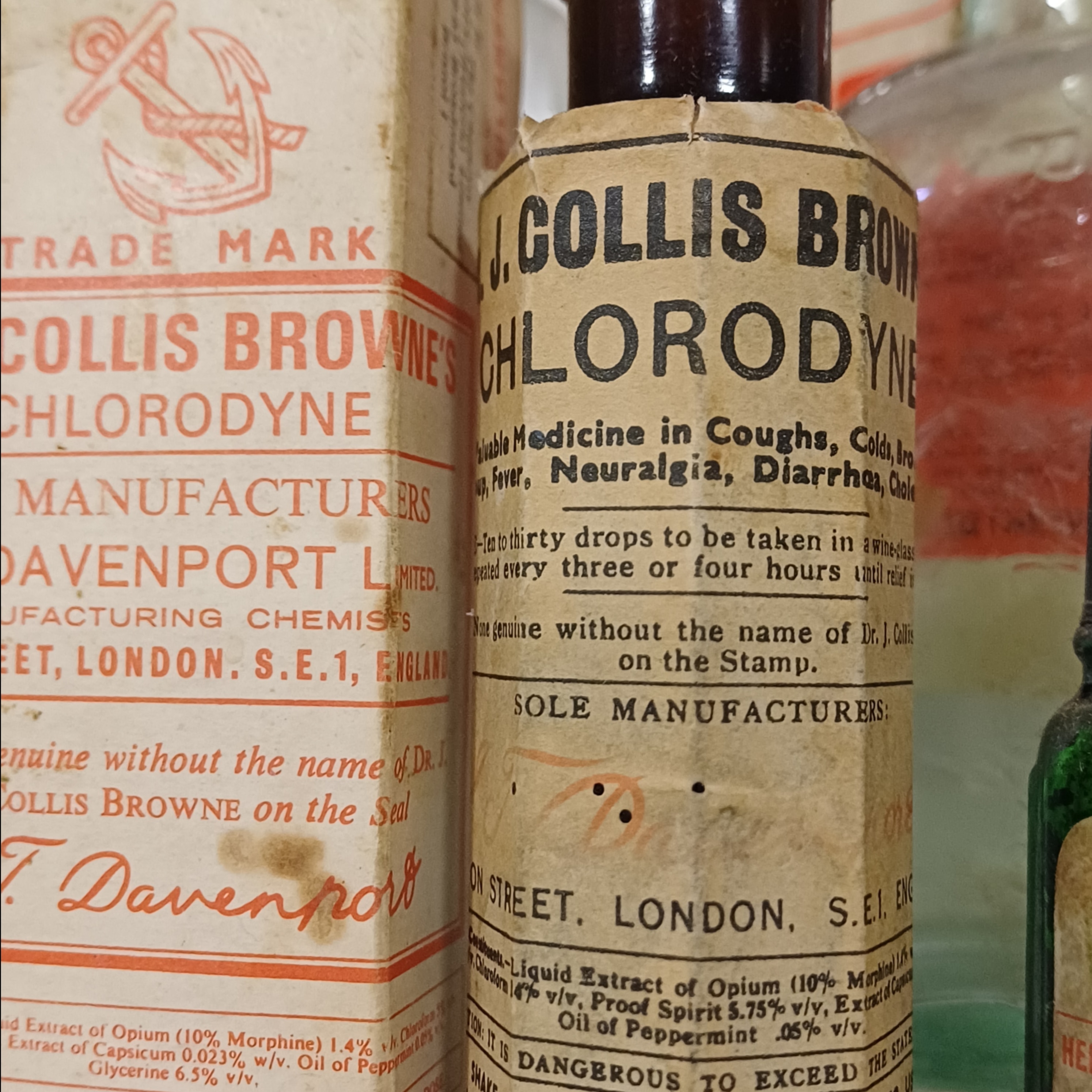
These bottles of Chlorodyne were found at an old pharmacy in Bristol.
Chlorodyne was one of the best known patent medicines sold in the British Isles. Patented in 1871 by Dr. John Collis Browne, a doctor in the British Indian Army, its original purpose was the treatment of cholera.
Browne sold his formula to the pharmacist John Thistlewood Davenport, who advertised it as a treatment for coughs, colds, diarrhea, insomnia, neuralgia, and migraines.
In 1884, while in Lahore, an 18-year-old Rudyard Kipling suffered a severe bout of dysentery and for relief smoked opium and ingested “a stiff dose of Chlorodyne.”
“There is convincing evidence that this double dose hit him with the force of a revelation,” writes his biographer Charles Allen. “In modern parlance, it ‘blew his mind,’ opening the doors of his unconscious hitherto kept tight shut and causing him to lose some of his fearfulness…. [It] brought a new dimension to his thinking, freeing him to speak more directly from within himself. It did not mean that he abandoned his former self, far from it. Rather it gave voice to another aspect of his personality, long suppressed: that of his Bombay childhood.”
Kipling wrote to his Aunt Edith the following day: “Here am I with my head still ringing like a bell from the fumes of that infernal opium, plotting and planning and crowing on my own dunghill as though I were one of the immortals.”
In the twentieth century, cannabis was removed from the formulation of Chlorodyne and its opiate content was progressively reduced.
 The Real Seed Company: The Honest Online Source for Cannabis Landraces Est. 2007