
For the new chat between Angus of the The Real Seed Company and Aussie Gunja Man here’s a brilliant painting of stoned yogis from 1780s Rajasthan, northwest India.
Comical paintings of ascetics (Hindu or Muslim) in states of extreme debauchery were a long-running trend in India by the 1700s, continuing a Persianate genre of ‘folks getting really high in parks’ that has roots in 1500s Herat, northwest Afghanistan.
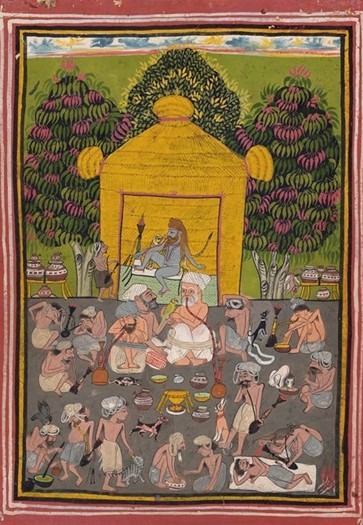
The dreadlocked figure who’s smeared in ash and sits on a charpoy in a reed hut is a senior Shaiva yogi, red-eyed and toking on a narghile or hookah (water pipe). The baked figures ranged about are his entourage, totally dined, smoking narghiles themselves, nodding out, or preparing brews of bhang.
The symbolic role of the animals in the scene could be interpreted through the Sufi teachings of the Nafs (human self or soul). At the lower levels of the Nafs is the Nafs al-Hayawaniyyah, debased animalistic urges, impulses, and desires, which drive toward immediate gratification in food, sex, possessions, and ‘drugs’ such as opium and cannabis.
Set at the centre of the scene is a more ambiguous, polyvalent symbol of Persianate mysticism: the green parrot. Perhaps its presence leaves open a question much-debated in the Indo-Persianate world of the day: is the ‘gyan‘ (trance, high, or knowledge) brought about by cannabis never more than a mere illusory ‘parroting’ of realization or can the experience serve as a conduit to authentic mystical intoxication (mastī)?
As we chat about in the podcast, this painting is among the earliest in India in which people are shown smoking cannabis in pipes. In literature, references to cannabis smoking appear about a century earlier: 1630s Persia for charas and 1670s South India for ganja. All postdate the introduction of tobacco to Eurasia from the Americas.
For the question of just how old the practice of toking the herb in pipes might be, check out How Ancient is Cannabis Smoking?
 The Real Seed Company: The Honest Online Source for Cannabis Landraces Est. 2007